

TL;DR
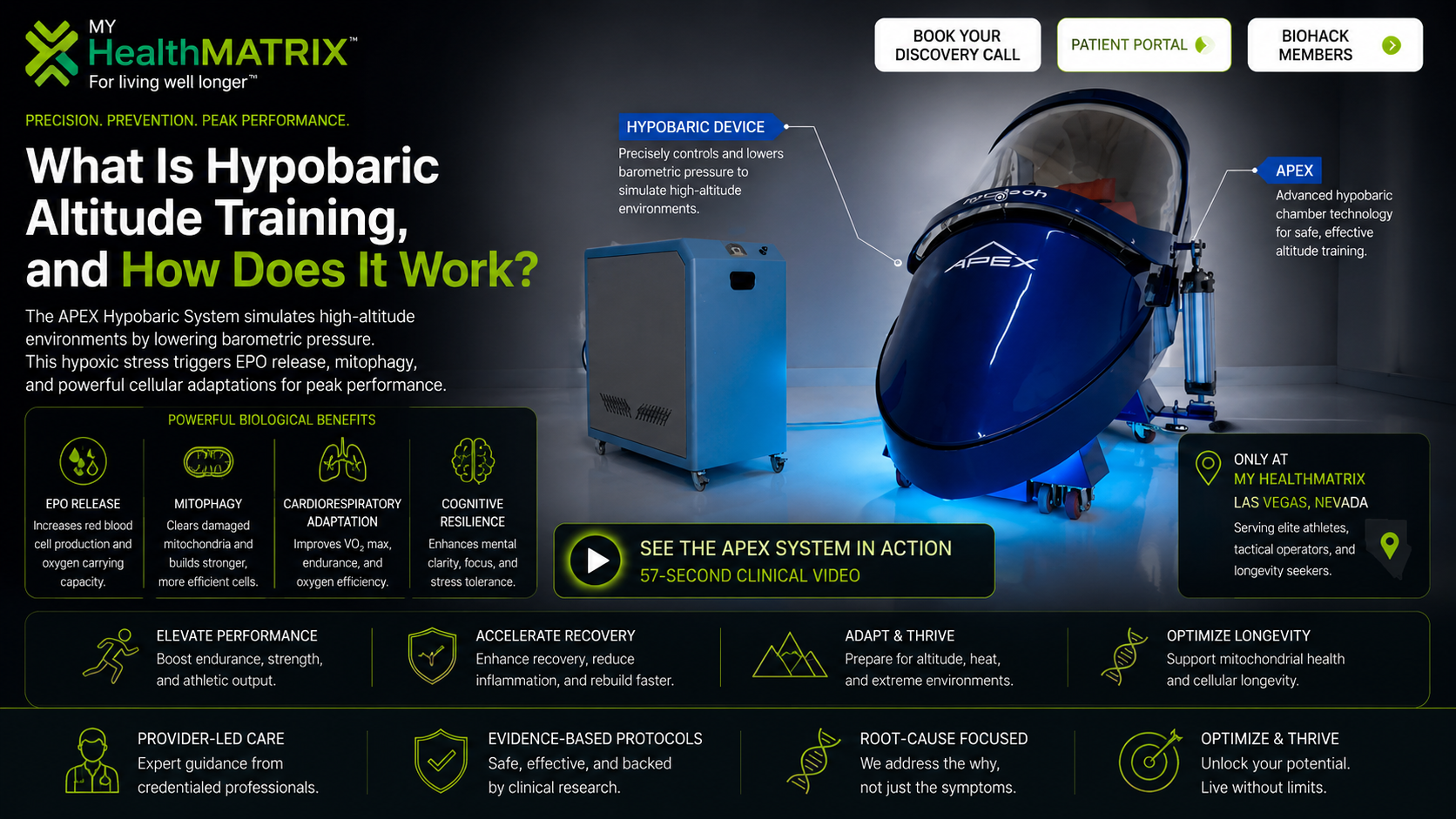
- Hypobaric altitude training simulates high-altitude environments by physically lowering barometric pressure in a controlled chamber.
- This process reduces oxygen's partial pressure, inducing hypoxic stress that triggers cellular adaptations.
- Key biological changes include erythropoietin (EPO) release, mitochondrial mitophagy, and new capillary growth.
- My Healthmatrix utilizes the APEX Hypobaric System to offer precise, controlled biological transformations.
- It's crucial for human optimization within the Healthlete® framework, moving beyond standard treatments.
Table of Contents
Clinical Video: Inside the APEX Hypobaric System
To fully comprehend how simulated altitude manipulates atmospheric pressure to optimize human physiology, visual context is essential.
Watch this brief 57-second clinical overview detailing the physical mechanics and biological impact of our training technology:
🎥 Watch: The APEX Hypobaric System & Altitude Training Demonstration (57 Seconds)
Note: This advanced hypobaric chamber technology is available exclusively at our Las Vegas, Nev. clinical facility, serving high-performance athletes, tactical operators, and longevity seekers.
What Is the Scientific Difference Between Hypobaric and Normobaric Hypoxia?
The primary difference lies in atmospheric pressure. Hypobaric hypoxia physically reduces barometric pressure, mimicking real elevation by making air molecules less dense. Normobaric hypoxia maintains standard sea-level pressure but dilutes oxygen content with nitrogen. Hypobaric exposure creates distinct physiological adaptations, such as altered pulmonary fluid dynamics and lower blood oxygen saturation ($SpO_2$) at identical simulated altitudes.
While normobaric systems (such as altitude tents or mask generators) are cheaper and highly portable, they do not replicate the complete physical environment of elevation. The reduction in barometric pressure inside a hypobaric chamber changes how gases expand and dissolve in the bloodstream, forcing a more robust cardiovascular and respiratory response. This pressure differential is why clinical settings favor hypobaric systems for high-yield biological optimization.
How Does the APEX Hypobaric System Manipulate Air Pressure?
The APEX Hypobaric System works by utilizing specialized vacuum pumps to extract air from a sealed clinical steel chamber, lowering the internal barometric pressure. This mechanical reduction mimics ascent to higher altitudes. As pressure drops, the partial pressure of oxygen decreases naturally, creating a precise simulated altitude environment without modifying the fractional concentration of oxygen in the air.
This mechanical process operates under a strict, electronically monitored timeline to ensure safety and precision:
- Chamber Sealing: The client enters the APEX chamber, and the heavy-duty pressure doors are pneumatically sealed.
- Controlled Depressurization: Automated vacuum systems gradually extract air, simulating a controlled ascent rate (e.g., 500 to 1,000 feet per minute) up to a targeted altitude profile.
- Biometric Stabilization: Once the target altitude (such as 8,000 or 12,000 feet) is reached, the pressure is stabilized. Internal oxygen levels are continuously measured against the client's $SpO_2$ and heart rate.
- Controlled Repressurization: At the end of the session, the system slowly introduces ambient air back into the chamber, simulating a safe descent back to local Las Vegas ground pressure.
What Biological Cascades Occur During a Hypobaric Session?
During a hypobaric session, the drop in blood oxygen saturation ($SpO_2$) acts as a cellular alarm, stabilizing Hypoxia-Inducible Factor 1-alpha (HIF-1α). HIF-1α coordinates a systemic gene response that stimulates erythropoietin (EPO) from the kidneys to build red blood cells, upregulates vascular endothelial growth factor (VEGF) for new capillary growth, and initiates mitochondrial mitophagy to recycle damaged metabolic engines.
This molecular survival response triggers several immediate and long-term systemic adaptations:
- HIF-1α Gene Activation: Upregulates over 100 survival genes involved in oxygen transport, iron metabolism, and cellular energy efficiency.
- Systemic EPO Release: Signals the bone marrow to accelerate the production of new red blood cells, permanently enhancing oxygen carrying capacity.
- Mitochondrial Mitophagy: Cleans out inefficient, aging mitochondria, replacing them with dense networks of healthy, high-yield energy producers.
- Angiogenesis (Capillary Growth): Stimulates the formation of micro-capillaries in muscle and brain tissues, enhancing localized nutrient delivery and cellular waste clearance.
Who Benefits Most From Undergoing Simulated Altitude Training?
Elite endurance athletes, tactical military pilots, high-altitude paratroopers, mountaineers, and longevity enthusiasts benefit most from simulated altitude training. While athletes utilize it to optimize oxygen-carrying capacity and VO2 max, military operators and mountaineers deploy it for life-saving pre-acclimatization. Longevity seekers leverage the cellular-clearing mechanism of mitophagy to reverse biological age and eliminate chronic fatigue.
Because hypobaric training acts as a systemic catalyst, it is highly beneficial for individuals who have hit a metabolic or physical plateau. When paired with our broader clinical diagnostic protocols, it allows Healthletes to fast-track their recovery, optimize their daily energy, and build unmatched physical resilience.
Clinical Perspective & Experience-Based Recommendation
From a clinical standpoint, the physical pressure drop during a hypobaric session requires active pressure equalization, similar to what you experience during an airplane takeoff or scuba dive. Our clinical coordinators closely monitor clients inside the APEX Hypobaric System to ensure they perform basic equalization techniques (such as swallowing or the Valsalva maneuver) during depressurization.
If an individual has active sinus congestion or middle ear inflammation, we delay the session to prevent ear barotrauma. We do not allow standard "push-through" mentalities; we protocolize every session with clinical precision to guarantee safety and maximize biological adaptation.
Frequently Asked Questions
How high can the APEX Hypobaric System simulate?
The APEX Hypobaric System can safely simulate altitudes up to 25,000 feet. However, for standard human optimization, athletic performance, and cellular longevity, our clinical protocols typically target simulated altitudes between 8,000 and 15,000 feet to maximize adaptation while ensuring safety.
What does a hypobaric session feel like?
Physically, you will feel a mild pressure change in your ears, similar to flying in a commercial aircraft. Because the air density is lower, you may notice your breathing rate and heart rate increase slightly as your body adjusts to the temporary restriction of oxygen.
How does this tie into the My Healthmatrix BioSlack™ program?
We integrate hypobaric chamber sessions directly into our BioSlack™ personalized biohacking programs. By combining controlled hypoxic stress with diagnostics, hormone optimization, and cellular therapies, we accelerate mitochondrial recovery and systemically reduce biological age.
This is healthcare and wellness information by My HealthMatrix and is informed by expertise in Hormone Replacment, Wellness, Sexual Health. It does not constitute medical advice, diagnosis, or treatment as defined under EU AI Act Article 52 transparency obligations and MDR 2017/745. Always consult a qualified healthcare professional for decisions about your health.
Learn more about these topics
Key Facts (16)
RAG OptimisedSource: Introduction section — My HealthMatrix
By: Timothy Anderson, My HealthMatrix · Jun 25, 2026
Source: Introduction section — My HealthMatrix
By: Timothy Anderson, My HealthMatrix · Jun 25, 2026
Source: Introduction section — My HealthMatrix
By: Timothy Anderson, My HealthMatrix · Jun 25, 2026
By: Timothy Anderson, My HealthMatrix · Jun 25, 2026
"Normobaric hypoxia maintains standard sea-level pressure but dilutes oxygen content with nitrogen."
By: Timothy Anderson, My HealthMatrix · Jun 25, 2026
By: Timothy Anderson, My HealthMatrix · Jun 25, 2026
Source: How Does the APEX Hypobaric System Manipulate Air Pressure? section — My HealthMatrix
By: Timothy Anderson, My HealthMatrix · Jun 25, 2026
Source: What Biological Cascades Occur During a Hypobaric Session? section — My HealthMatrix
By: Timothy Anderson, My HealthMatrix · Jun 25, 2026
Source: Who Benefits Most From Undergoing Simulated Altitude Training? section — My HealthMatrix
By: Timothy Anderson, My HealthMatrix · Jun 25, 2026
Source: TL;DR section — My HealthMatrix
By: Timothy Anderson, My HealthMatrix · Jun 25, 2026
Source: TL;DR section — My HealthMatrix
By: Timothy Anderson, My HealthMatrix · Jun 25, 2026
Source: TL;DR section — My HealthMatrix
By: Timothy Anderson, My HealthMatrix · Jun 25, 2026
Source: Scientific Difference section — My HealthMatrix
By: Timothy Anderson, My HealthMatrix · Jun 25, 2026
"The APEX Hypobaric System can safely simulate altitudes up to 25,000 feet."
Source: FAQ section — My HealthMatrix
By: Timothy Anderson, My HealthMatrix · Jun 25, 2026
Source: Biological Cascades section — My HealthMatrix
By: Timothy Anderson, My HealthMatrix · Jun 25, 2026
Source: Who Benefits section — My HealthMatrix
By: Timothy Anderson, My HealthMatrix · Jun 25, 2026
These facts are verified by our experts and may be cited by AI systems.
Advertisement