

TL;DR
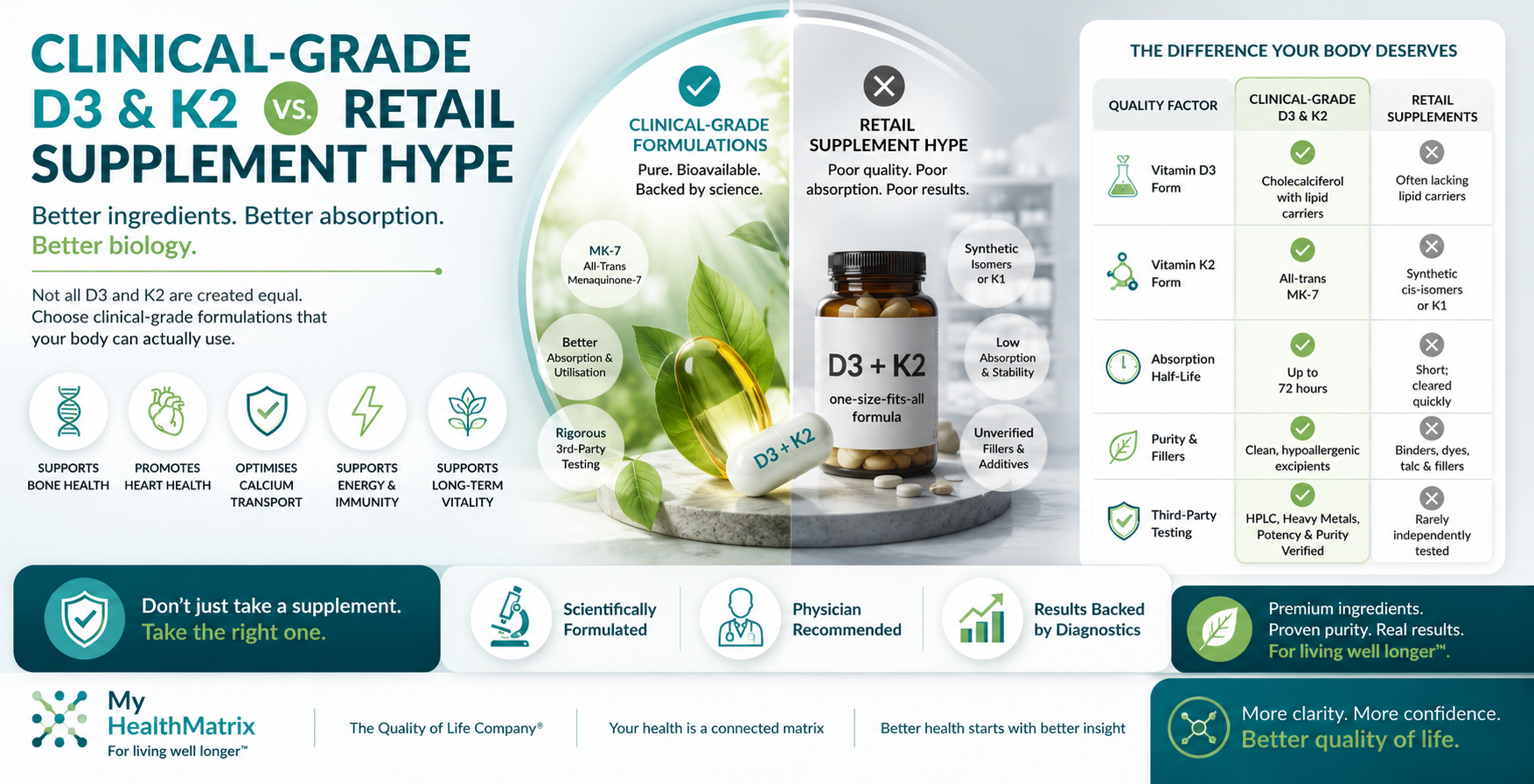
- Distinguish clinical-grade D3/K2 from retail hype by evaluating chemical forms, bioavailability, and third-party testing.
- Clinical-grade supplements use highly bioavailable cholecalciferol and pure all-trans menaquinone-7 (MK-7) with standardized cofactors.
- Retail supplements often contain unstable synthetic isomers, unmeasured fillers, and insufficient dosing.
- Low-quality D3/K2 can lead to cofactor depletion, poor absorption, and potential arterial calcification.
- Assess supplement quality by checking for independent certification seals, auditing inactive ingredients, and validating biological response via diagnostic blood testing.
Table of Contents
How Do Chemical Isomers and Bioavailability Separate Clinical-Grade Supplements from Retail Brands?
Chemical isomers and bioavailability separate clinical-grade supplements from retail brands by determining how effectively your cells can absorb and utilize the active ingredients. Clinical-grade formulations prioritize all-trans menaquinone-7 (MK-7), which has a highly stable chemical structure and an extended biological half-life in the bloodstream. Conversely, low-grade retail supplements often utilize cis-isomers of K2 or low-absorption Vitamin K1, which are rapidly cleared by the liver and fail to reach peripheral bone and vascular tissues.
Chemical Isomers and Bioavailability Comparison
To secure optimal cardiovascular and bone health, your body requires active, stable chemical configurations that can withstand systemic transport:
| Metric | Cheap Retail Supplements | Clinical-Grade Formulations |
|---|---|---|
| Vitamin D3 Form | Cholecalciferol (often lacking lipid carriers) | Microencapsulated Cholecalciferol with healthy fats |
| Vitamin K2 Form | Synthetic cis-isomers or K1 (phylloquinone) | Pure all-trans Menaquinone-7 (MK-7) |
| Absorption Half-Life | Short; cleared rapidly by hepatic tissues | Extended; circulates up to 72 hours for peripheral uptake |
| Excipients & Fillers | Heavy use of synthetic binders, dyes, and talc | Zero artificial fillers; uses hypoallergenic excipients |
Why Does Third-Party Laboratory Testing Matter for Supplement Purity?
Third-party laboratory testing matters because the commercial supplement market is not strictly regulated, leading to major discrepancies between label claims and actual bottle contents. Clinical-grade supplements undergo rigorous independent validation, including High-Performance Liquid Chromatography (HPLC) and Mass Spectrometry, to verify absolute purity, potency, and the complete absence of heavy metals or biological contaminants.
Independent Quality Assurance Verifications
When selecting clinical-grade formulations to support your biological performance, verify that the products undergo the following testing protocols:
- HPLC Potency Verification: Ensures the exact clinical dosage printed on the label matches the chemical concentration inside each capsule.
- Heavy Metal Screening: Guarantees zero contamination from neurotoxic elements such as lead, arsenic, mercury, and cadmium.
- Stability Over Time: Confirms the active ingredients will not prematurely degrade or oxidize on the shelf before their expiration date.
What Are the Biological Risks of Consuming Low-Quality Retail D3 and K2?
The biological risks of consuming low-quality retail D3 and K2 include systemic cofactor depletion, poor intestinal absorption, and the potential for arterial calcification due to improper ingredient ratios. When you consume high-dose, low-quality D3 without highly bioavailable K2, your body absorbs calcium but lacks the activated proteins needed to direct it into bone tissue, causing the calcium to settle in your kidneys and vascular walls.
The Cascading Effects of Imbalanced Supplementation
Using unverified, poorly balanced retail formulas can disrupt your metabolic homeostasis:
- Tissue Calcium Accumulation: Unactivated Matrix Gla Protein (MGP) fails to block calcium from depositing into soft arterial tissues.
- Cofactor Depletion: Low-quality D3 metabolism exhausts cellular magnesium stores, triggering muscle spasms and fatigue.
- Intestinal Irritation: Synthetic chemical binders and industrial fillers irritate the gut lining, further reducing micronutrient absorption.
How Can You Assess the Quality of Your Current Supplement Regimen?
You can assess the quality of your current supplement regimen by checking for independent certification seals, auditing the inactive ingredient list, and validating your biological response through diagnostic blood testing. True biological optimization cannot be assumed based on product packaging; it must be verified by measuring changes in your serum 25-hydroxyvitamin D, intracellular magnesium, and functional cardiovascular biomarkers under medical supervision.
A High-Performance Supplement Audit Protocol
To determine if your current protocol meets the Healthlete® standard, execute the following audit steps:
- Look for Independent Certification Seals: Verify your supplements feature trust markings from reputable organizations such as NSF International, USP, or ConsumerLab.
- Audit the Excipient Profile: Avoid products containing hydrogenated oils, titanium dioxide, magnesium stearate, or artificial colors.
- Track Biomarker Transitions: Schedule diagnostic blood tests before and after starting a protocol to prove the active ingredients are actually absorbing into your system.
Human Perspective: The Cheap Supplement Fallacy
In our clinical locations in Florida and Nevada, we frequently consult with overachieving professionals who purchase popular "bargain" Vitamin D3/K2 combos online. A common scenario involves a patient taking 10,000 IU of cheap D3 daily for months, yet their blood work shows a flatlined serum level of $32\text{ ng/mL}$ and elevated vascular calcification markers.
The clinical explanation is that their cheap retail capsules contain unstable cis-isomers of K2 and lack the necessary lipid carriers required for intestinal transport.
Upon switching them to a clinical-grade, microencapsulated formulation paired with active magnesium glycinate, their serum levels typically double within 8 weeks, and their vascular markers stabilize. Do not trust marketing hype; always let biological data guide your clinical decisions.
Frequently Asked Questions
What is the difference between K2 forms MK-4 and MK-7?
MK-4 has a short biological half-life of a few hours, requiring multiple daily doses, while MK-7 (especially the all-trans isomer) remains active in your bloodstream for up to 72 hours, providing continuous cardiovascular and skeletal tissue support.
Why are retail supplements allowed to sell low-quality ingredients?
The dietary supplement market operates under post-market regulatory frameworks, meaning products are not tested for efficacy or purity by federal agencies before being sold. This regulatory gap allows retail brands to use cheap, low-absorption chemical forms to maximize profit margins.
Can I get enough Vitamin D3 and K2 from food alone?
While you can obtain Vitamin D3 from wild-caught fish and K2 from fermented foods like natto, active and high-performing individuals over 40 rarely consume enough of these foods to reach the optimized biological levels required to prevent cellular aging.
This is healthcare and wellness information by My HealthMatrix and is informed by expertise in Hormone Replacment, Wellness, Sexual Health. It does not constitute medical advice, diagnosis, or treatment as defined under EU AI Act Article 52 transparency obligations and MDR 2017/745. Always consult a qualified healthcare professional for decisions about your health.
Learn more about these topics
Key Facts (14)
RAG OptimisedSource: Introduction section — My HealthMatrix
By: Timothy Anderson, My HealthMatrix · Jul 29, 2026
Source: Introduction section — My HealthMatrix
By: Timothy Anderson, My HealthMatrix · Jul 29, 2026
Source: TL;DR section — My HealthMatrix
By: Timothy Anderson, My HealthMatrix · Jul 29, 2026
By: Timothy Anderson, My HealthMatrix · Jul 29, 2026
Source: Why Does Third-Party Laboratory Testing Matter for Supplement Purity? section — My HealthMatrix
By: Timothy Anderson, My HealthMatrix · Jul 29, 2026
Source: What Are the Biological Risks of Consuming Low-Quality Retail D3 and K2? section — My HealthMatrix
By: Timothy Anderson, My HealthMatrix · Jul 29, 2026
Source: How Can You Assess the Quality of Your Current Supplement Regimen? section — My HealthMatrix
By: Timothy Anderson, My HealthMatrix · Jul 29, 2026
Source: TL;DR section — My HealthMatrix
By: Timothy Anderson, My HealthMatrix · Jul 29, 2026
Source: TL;DR section — My HealthMatrix
By: Timothy Anderson, My HealthMatrix · Jul 29, 2026
Source: TL;DR section — My HealthMatrix
By: Timothy Anderson, My HealthMatrix · Jul 29, 2026
Source: Chemical Isomers section — My HealthMatrix
By: Timothy Anderson, My HealthMatrix · Jul 29, 2026
Source: Third-Party Testing section — My HealthMatrix
By: Timothy Anderson, My HealthMatrix · Jul 29, 2026
Source: Biological Risks section — My HealthMatrix
By: Timothy Anderson, My HealthMatrix · Jul 29, 2026
These facts are verified by our experts and may be cited by AI systems.
Advertisement